
FOOD TRUCK
Business Game

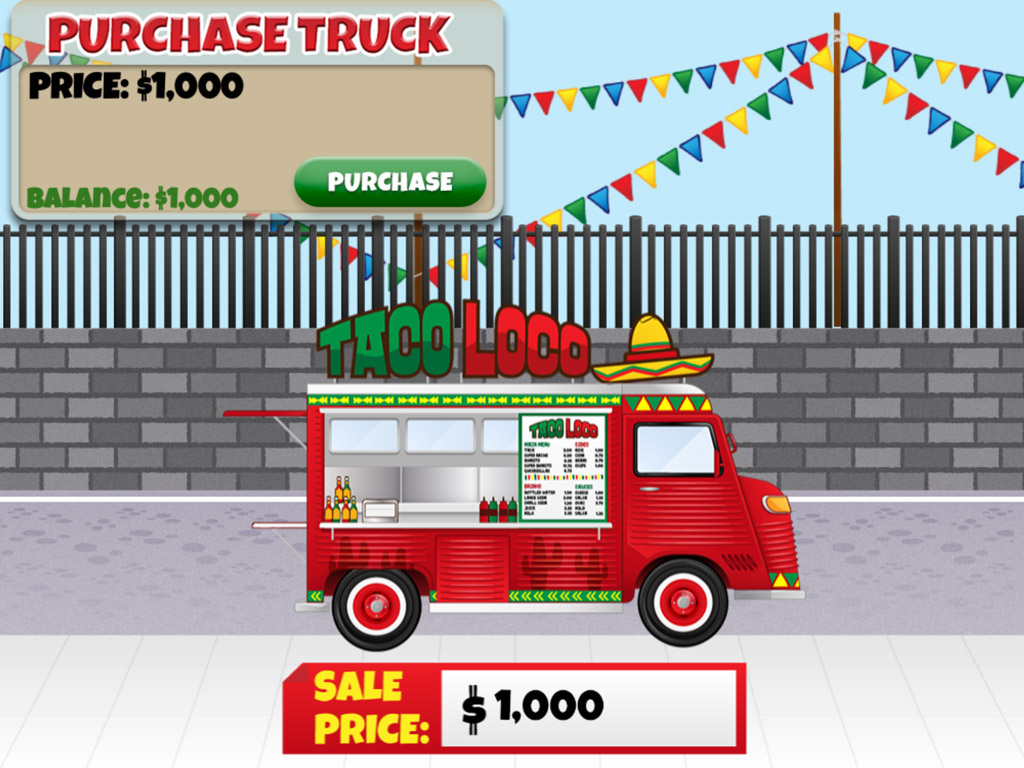
Get a loan and start a business! Players are engaged in the basics of economics, entrepreneurship, and money. As they build their business they will learn about loans, counting currency, paying bills, and the importance of building good credit. Can you serve enough customers to get all of the trucks paid off?!
Educational Standards:
Productive resources are limited. Therefore, people cannot have all the goods and services they want; as a result, they must choose some things and give up others.
- Goods are objects that can satisfy people's wants; services are actions that can satisfy people's wants.
- People who make goods and provide services are called producers. People whose wants are satisfied by using goods and services are called consumers.
- Entrepreneurs are people who organize other productive resources to make goods and services.
Voluntary exchange occurs only when all participating parties expect to gain. This is true for trade among individuals or organizations within a nation, and usually among individuals or organizations in different nations.
- Exchange is trading goods and services with people for other goods and services or for money.(a)
- People voluntarily exchange goods and services because they expect to be better off after the exchange.(b)
Markets exist when buyers and sellers interact. This interaction determines market prices and thereby allocates scarce goods and services.
- A price is what people pay when they buy a good or service, and what they receive when they sell a good or service.(a)
- A market exists whenever buyers and sellers exchange goods and services.(b)
- Most people produce and consume. As producers they make goods and services; as consumers they use goods and services.(c)
Prices send signals and provide incentives to buyers and sellers. When supply or demand changes, market prices adjust, affecting incentives.
- High prices for a good or service provide incentives for buyers to purchase less of that good or service, and for producers to make or sell more of it. Lower prices for a good or service provide incentives for buyers to purchase more of that good or service, and for producers to make or sell less of it.
Competition among sellers lowers costs and prices, and encourages producers to produce more of what consumers are willing and able to buy. Competition among buyers increases prices and allocates goods and services to those people who are willing and able to pay the most for them.
- Competition takes place when there are many buyers and sellers of similar products.(a)
- Competition among sellers results in lower costs and prices, higher product quality, and better customer service.(b)
Institutions evolve in market economies to help individuals and groups accomplish their goals. Banks, labor unions, corporations, legal systems, and not-for-profit organizations are examples of important institutions. A different kind of institution, clearly defined and enforced property rights, is essential to a market economy.
- Banks are institutions where people save money and earn interest, and where other people borrow money and pay interest.(a)
- Saving is the part of income not spent on taxes or consumption(b)
Money makes it easier to trade, borrow, save, invest, and compare the value of goods and services.
- Money is anything widely accepted as final payment for goods and services.(a)
- People consume goods and services, not money; money is useful primarily because it can be used to buy goods and services.(c)
Entrepreneurs are people who take the risks of organizing productive resources to make goods and services. Profit is an important incentive that leads entrepreneurs to accept the risks of business failure.
- Entrepreneurs are individuals who are willing to take risks, to develop new products, and start new businesses. They recognize opportunities, like working for themselves, and accept challenges.(a)
- Entrepreneurs often are innovative. They attempt to solve problems by developing and marketing new or improved products.(c)